
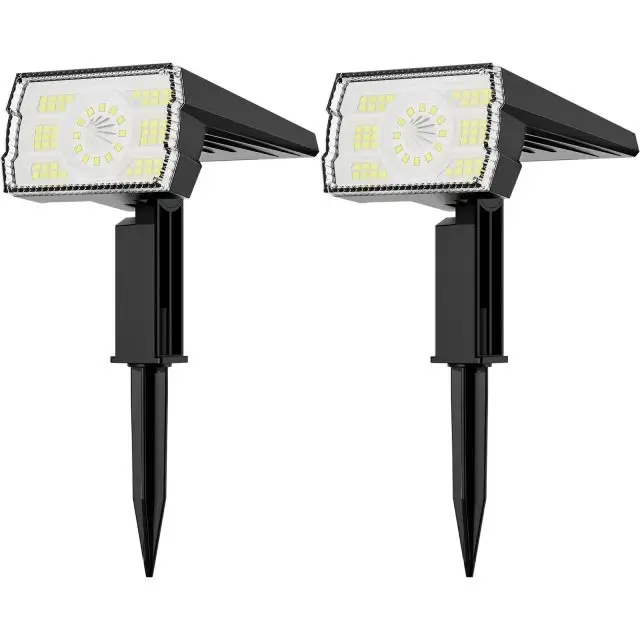
As the world transitions to renewable energy, Solar LED Spotlights are at the forefront of Efficient Solar Lighting, revolutionizing outdoor illumination. According to the International Energy Agency (IEA) 2024 report, solar power capacity grew by 22% annually, reflecting a global shift toward sustainable solutions. Lighting accounts for 15%-20% of global electricity consumption, making innovations like Solar LED Spotlights critical for reducing energy use. These lights offer zero grid dependency, low-carbon operation, and smart adaptability, making them ideal for applications in gardens, pathways, security, off-grid areas, and green buildings. This article explores the cutting-edge technology behind Solar LED Spotlights, their efficiency advantages, and their transformative potential.
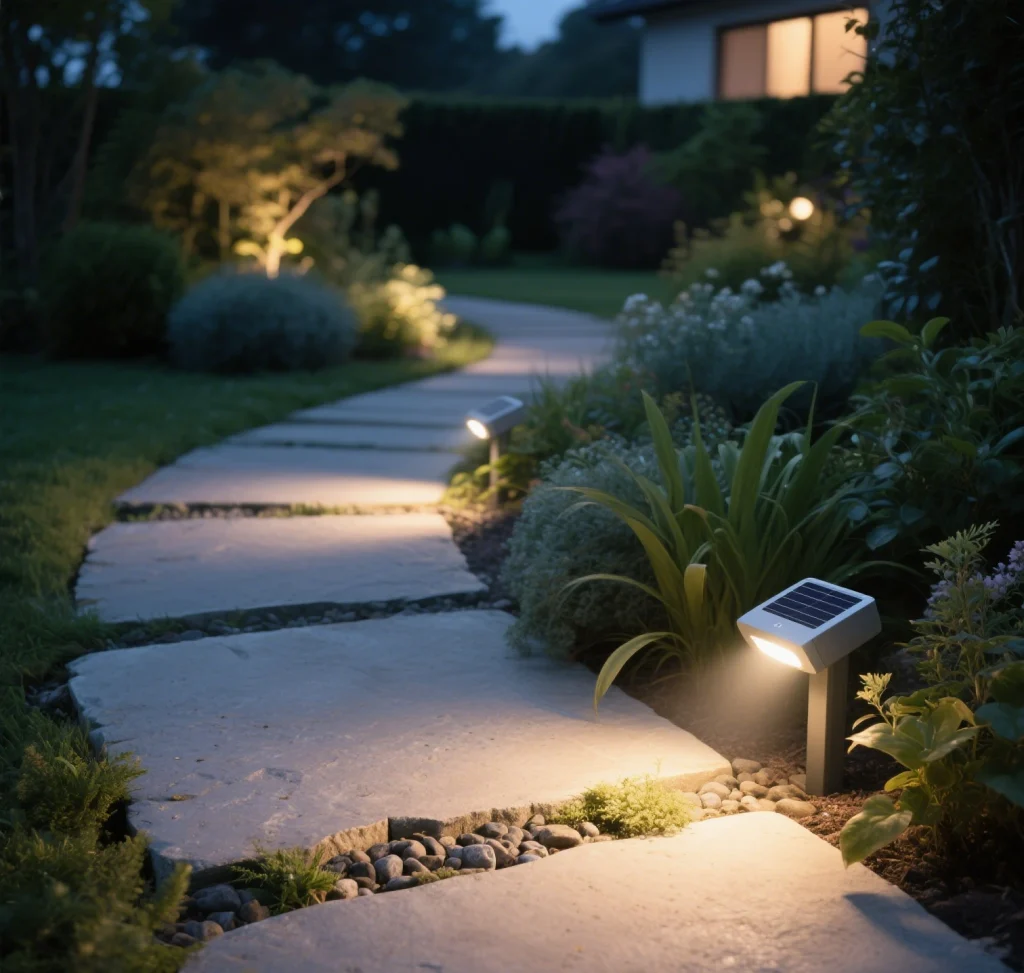
Photovoltaic Systems: The Core of Energy Capture
Photovoltaic Cell Technology and Efficiency
The heart of Solar LED Spotlights lies in their photovoltaic (PV) systems, particularly Monocrystalline Solar Panels. These panels, made from a single silicon crystal, achieve light-to-electricity conversion efficiencies of 22%-26%, outperforming polycrystalline (18%-22%) and thin-film (10%-14%) alternatives, according to the National Renewable Energy Laboratory (NREL) 2024 report. Costing $0.25-$0.35 per watt, Monocrystalline Solar Panels offer a lifespan of 25-30 years, ensuring long-term reliability. Emerging technologies, such as perovskite-silicon tandem cells with lab efficiencies exceeding 33.9% (Science, 2023), and flexible PV films for curved designs, promise even greater efficiency for future Solar LED Spotlights.
Energy Management Systems
Energy Management Systems (EMS) optimize power collection and usage. Maximum Power Point Tracking (MPPT) controllers, using algorithms like Perturb and Observe (P&O) or Incremental Conductance (INC), boost energy collection by 10%-30%, per IEEE Transactions on Sustainable Energy. The storage component relies on Long-Life Batteries, typically lithium iron phosphate (LiFePO4), with energy densities of 100-160 Wh/kg, 2000-3000 cycles, and a low self-discharge rate of 2-3% per month, compared to lead-acid batteries’ 30-50 Wh/kg and 300-500 cycles (US DOE data). These Energy Management Systems ensure Low-Light Efficiency, enabling consistent performance even in overcast conditions.
High-Efficiency LED Lighting Design
LED Light Source Parameters
LED Lighting Technology is pivotal to the efficiency of Solar LED Spotlights. Modern LED chips, like the Cree XHP70.2, deliver light efficacy of 120-160 lumens per watt, far surpassing traditional halogen bulbs. Color temperatures are tailored to applications: 3000K warm light for cozy garden settings and 5000K cool light for security illumination. Optical systems, such as Fresnel lenses with less than 5% light loss and beam angles of 20°-60°, or reflective cups with over 95% reflectivity, ensure precise light distribution, maximizing the impact of LED Lighting Technology.
Thermal Management
Effective thermal management extends the lifespan of LED Lighting Technology. Aluminum fin heat sinks, with thermal resistance of 5-8 K/W, dissipate heat efficiently, and graphene coatings can improve heat dissipation by 20%. For high-power spotlights (>50W), heat pipes offer 100 times the thermal conductivity of aluminum alone. Maintaining low junction temperatures is critical, as a 10°C increase can halve LED lifespan (LEDinside report). These advancements ensure Solar LED Spotlights remain reliable under demanding conditions.
System Efficiency and Energy-Saving Features
Full-Chain Efficiency Analysis
The efficiency of Solar LED Spotlights is calculated as (\eta_{system} = \eta_{PV} \times \eta_{storage} \times \eta_{LED} \times \eta_{optics}), yielding a typical system efficiency of 15%-20%, compared to 5%-10% for traditional halogen spotlights. This high efficiency reduces energy waste, making Efficient Solar Lighting a sustainable choice for outdoor applications.
Smart Control Systems
Smart Control Systems enhance energy savings. Passive Infrared (PIR) sensors respond in under 0.5 seconds with a false trigger rate below 1%, activating lights only when needed. Adjustable light thresholds (5-200 Lux) and PWM dimming (0-100% depth, <3% efficiency loss) allow precise control. Time-based strategies, such as reducing power to 30% after midnight, can save 30%-50% energy, ensuring Low-Light Efficiency and extending battery life.
Comparative Advantages and Real-World Applications
Solar vs Traditional Lighting
When comparing Solar vs Traditional Lighting, Solar LED Spotlights excel in cost and environmental impact. A 20W solar spotlight costs $80-$150 upfront but incurs zero energy costs, compared to a 50W halogen spotlight costing $30-$60 with $50-$80 annual energy expenses (1000 hours/year at $0.15/kWh). Carbon emissions are minimal (<5 kgCO₂/year) versus 80-120 kgCO₂ for halogen and 20-30 kgCO₂ for grid-powered LEDs.
Solar Spotlight Applications
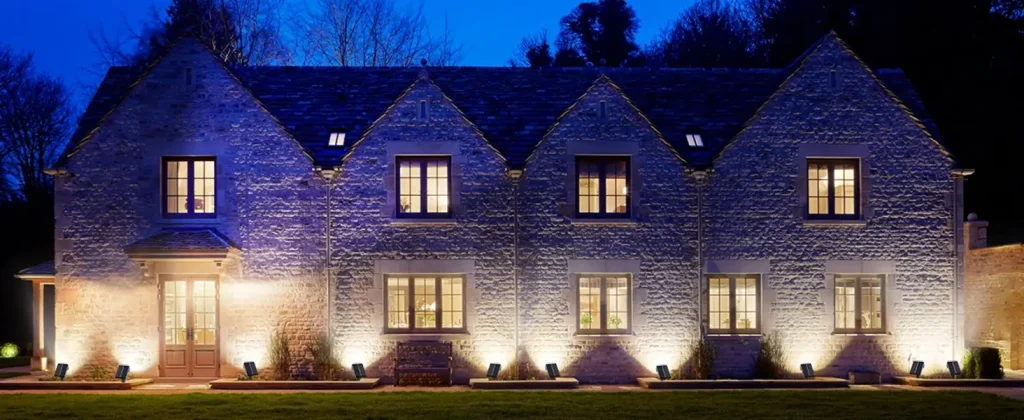
Real-world Solar Spotlight Applications highlight their impact. In an industrial park, 100 20W Solar LED Spotlights saved $12,000 annually in electricity and reduced carbon emissions by 48 tons. In an off-grid African community, a system with 50W PV panels and 10Ah Long-Life Batteries provided 12 hours of daily lighting, with a 2.8-year payback period (World Bank data). These cases demonstrate the scalability and economic benefits of Solar LED Spotlights.
Technical Challenges and Future Trends
Current Challenges
Despite their advantages, Solar LED Spotlights face challenges. Overcast weather can limit battery runtime, though solid-state batteries with 500 Wh/kg energy density are in development. Initial costs remain higher than traditional lights, but PV costs have dropped 89% since 2010 (IEA data), improving affordability.
Future Innovations
Emerging trends include integrated PV-LED designs, where transparent solar panels double as light covers, and smart microgrid integration for vehicle-to-grid (V2G) applications. Gallium nitride (GaN) drivers could boost power supply efficiency to 95%, further enhancing Efficient Solar Lighting.
Conclusion
Solar LED Spotlights represent a pinnacle of Efficient Solar Lighting, driven by Monocrystalline Solar Panels, LED Lighting Technology, Long-Life Batteries, and Smart Control Systems. Their superior efficiency, low carbon footprint, and adaptability make them ideal for diverse Solar Spotlight Applications. Compared to traditional lighting, Solar vs Traditional Lighting shows clear advantages in cost and sustainability. Despite challenges, innovations like high-density batteries and integrated designs promise a bright future. With the global solar lighting market projected to reach $12.7 billion by 2030 (MarketsandMarkets, CAGR 18%), Solar LED Spotlights are set to lead the charge toward a sustainable, efficient lighting future.
Leave a Reply